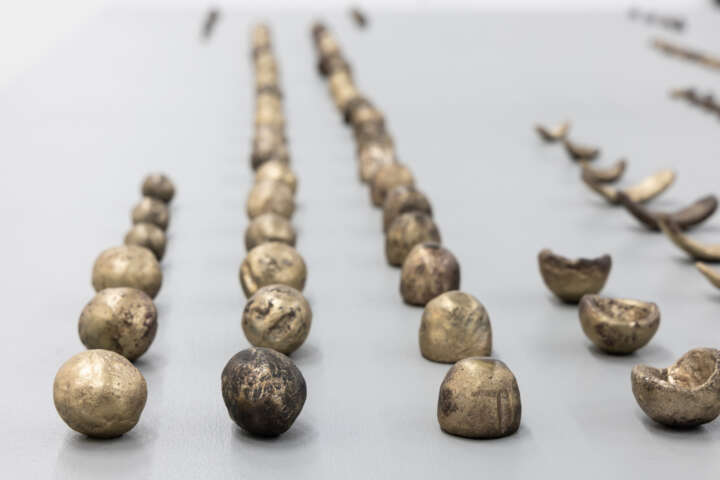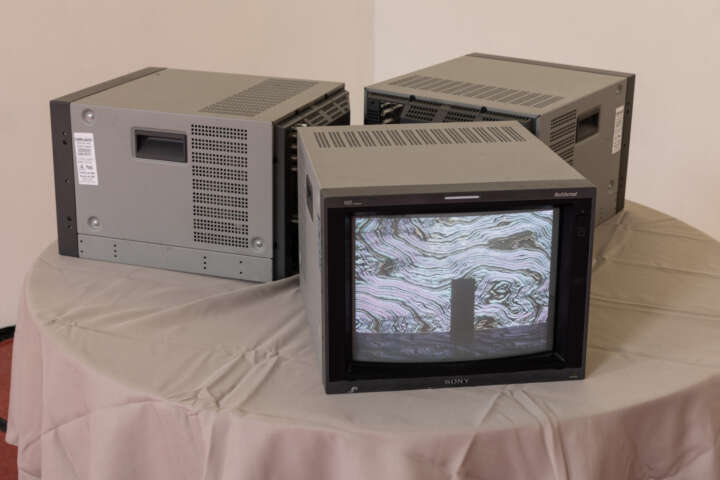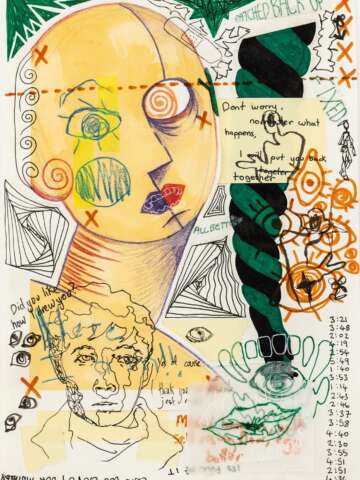
His pupils dilate until the infinitesimal becomes observable, and he begins to apprehend how little he knows, how little he is.¹ He grows aware of tacit, omnipresent processes, and of the Thou of every subject.² He learns that relation is reciprocity; that bodies are permeable and collaborative; that opaque unknowability can serve to protect.³⁻⁵ That things do not cease to exist without being named.⁶ The passages "parry, reverse, and redirect the questioning until it finally culminates in a meaningful resolution,” which he frequently confuses with gnosis.⁷ Discredited beliefs have a habit of being pushed into the realm of the imaginary and recycled in works of fiction;⁸ here, he religiously seeks salvation.
Roland Barthes writes extensively of reading as an inherently erotic practice and of perversion as the realm of textual jouissance:
We can imagine a typology of the pleasures of reading - or of the readers of pleasure; [...] linking the reading neurosis to the hallucinated form of the text. The fetishist would be matched with the divided-up text, the singling out of quotations, formulae, turns of phrase, with the pleasure of the word. [...] A paranoiac would consume or produce complicated texts, stories developed like arguments, constructions posited like games, like secret constraints.⁹
The evening before he read Barthes, he masturbated and came to the flow of words and the wittiness of metaphors in a cancer memoir, despite several months of antidepressant-induced lack of libido. He has not read a work of fiction in three months, and in the three months before that, deeply paranoid about intaking information that isn't cosmically significant. A fanatic is born - one who has stopped enjoying and suffers instead,¹⁰ "for nothing short of godlike perfection can fulfil his idealised image of himself and satisfy his pride in the exalted attributes which (so he feels) he has, could have, or should have."¹¹
An acquaintance once gave him a tarot reading. First card: Greed.
To Lee Edelman, collectivity operates through the logic of “reproductive futurism,” whereby structures must be continuously affirmed, reproduced and transmitted to a perpetual, salvific horizon in the hope of reaching not that which is to come, but that which is already understood as our being and accredited with meaning and potential. He perpetuates the meaning of 'A+'s, the meaning of erudition, the meaning of being good until he cannot read, can't breathe, cannot stop shaking, his mind illegible, his body obscure, both repulsive, but potentiality is never exhausted. "History [...] is always seen as needing another step, another link in the chain of its perpetuation."¹²
Symbolic reality [...] only ever invests us as subjects insofar as we invest ourselves in it. [...] It is only, after all, to its figures of meaning, which we take as the literal truth, that we owe our existence as subjects and the social relations within which we live - relations we may well be willing, therefore, to give up our lives to maintain.¹³
Time can only be apprehended through the relief of scrutinising skin and peeling away its layers to reach inside. Like nocturnal creatures who use the stars to navigate the world, he holds his course by relying on constellations of red dots: an empty sky would be disastrous. His degree is engraved on his back. Ritual is employed to solemnise institutions; so is the sacrifice involved.⁷
Reproductive futurism prohibits future as difference. Edelman views the queer - the refusal to participate in this logic - as an embodiment of the social order's death drive. This “[desire to die] is not the desire to disappear, and it is not suicide; it is the desire to enjoy” - but such pleasure requires a site of loss.⁹,¹⁴ Death presents a possibility “to refuse the insistence of hope itself as affirmation, which is always affirmation of an order whose refusal will register as unthinkable, irresponsible, inhumane.”¹¹
As a living organism, he spends all of his energy overcoming the drive towards disorder. "For [...] life processes to occur, the overall free energy changes in the organism must be negative; thus, life is an irreversible process. An organism that comes to equilibrium with its surroundings is dead."¹⁵
Read: a dead organism is in equilibrium with its surroundings.
His grandmother died when he was twelve, a few weeks after his family moved across the world. He never mourned her, mourning instead the loss of everything he knew. The disappearance felt the same: everybody died and kept on dying all the more every day, which meant she never died at all, disappearing into the void of lost contact. Whenever her name is mentioned, he is compelled to recite to an imagined interlocutor everything he has heard about her illness, her death and the fate of her things until he has convinced himself of the fact; she is remembered as his dead grandmother who is dead and buried somewhere he has never been and will probably never go.
The day after Alexey Navalny was murdered (16/02/2024) he felt the world was falling apart. He could not look at his cat without anticipating it to be crushed and bleed out, to get sick and waste away, to simply die of death then and there. Every second, he could feel his body, all bodies, rotting, expiring, dying (which is to say, living) all around him.
When he dies, he wants to disappear. Elsewhere, with no evidence but words is the way death has always occurred.
In Cruising Utopia, José Esteban Muñoz advocated for the embrace of loss in light of queerness's “vexed relationship” with evidence; in its illegibility, queerness is necessarily lost in relation to heteronormativity, and “to accept the way in which one is lost is to be also found and not found in a particularly queer fashion.”¹⁶ Though he desires to live this loss, to master the art of losing, he is afraid that accepting past losses means living through them all over again. The most space is occupied by absence. Dandelion Wine (or the version of it he recalls), revealing every attempt to hold onto the past to be futile and hopeless - scares and pains him more than any text has ever done.
He is comforted by depictions of the human body’s fatality, real or imagined, axiomatically bodily and thus reassuringly confronting. Provided that every representation of death is a misrepresentation, to give voice to a corpse is to represent the needs of the yet living.¹⁷
The heart swarms with maggots whose writhing, protruding silhouettes induce a subtle arrhythmia. Placed indeterminately on a spectrum between object and subject, the cadaverous presence (lack of absence) resists the myth of individual coherence and narrative resolution.
- 1. Clutterbuck. C. (2013). Forced Inspiration. In Volpert, M. (Ed.). This Assignment is So Gay: lgbtiq poets on the art of teaching. Sibling Rivalry Press.
- 2. Buber, M. (1923). I and Thou. T&T Clark.
- 3. Odell, J. (2019). How to Do Nothing: Resisting the Attention Economy. Melville House.
- 4. Gus Fisher Gallery. (2023, May 2). Zoom Webinar Recording: Hormone-Extraction Action with Mary Maggic [Video]. YouTube. https://www.youtube.com/watch?v=kBpZ72bKcwg
- 5. Heinemann, C. (2014). Magic Work: Queerness as Remystification. In Sutcliffe, J. (Ed.). Magic (pp. 331-339). The MIT Press.
- 6. Mika, C., Andreotti, V., Cooper, G., Ahenakew, C., Silva, D. (2020). The Ontological Differences Between Wording and Worlding the World. Language, Discourse & Society, 8(1), 17-32.
- https://www.language-and-society.org/wp-content/uploads/2021/07/Mika-et-al._Language-Discourse-Society_Vol81_June2020-21-36.pdf
- 7. Park, G. K. (1963). Divination and its Social Contexts. The Journal of the Royal Anthropological Institute of Great Britain and Ireland, 93(2), 195-209. https://doi.org/10.2307/2844242
- 8. Nelson, V. (2001). Grotto, An Opening. In Sutcliffe, J. (Ed.). Magic (pp. 32-37). The MIT Press.
- 9. Barthes, R. (1975). The Pleasure of the Text. Hill and Wang.
- 10. Hine, P. (2004). The pseudonomicon. Dagon Productions.
- 11. Horney, K. (1991). Neurosis and human growth: the struggle toward self-realization. Norton.
- 12. The Dissenter. (2022, December 10). #715 Lee Edelman - No Future: Queer Theory and the Death Drive [Video]. YouTube. https://www.youtube.com/watch?v=R-kg4QRa3lc
- 13. Edelman, L. (2004). No Future: Queer Theory and the Death Drive. Duke University Press.
- 14. Cixous, H. (1993). Three steps on the ladder of writing. Columbia University Press.
- 15. Appling, D., Anthony-Cahill, S., Mathews, C. (2016). Biochemistry: Concepts and Connections (2nd ed.). Pearson Education Limited.
- 16. Munoz, J. E. (2009). Cruising Utopia: The Then and There of Queer Futurity. New York University Press.
- 17. Goodwin, S. W., Bronfen, E. Introduction. In Goodwin, S. W., Bronfen, E. (Eds.). Death and Representation. The John Hopkins University Press.
Please contact valieva.alfia19@gmail.com if you would like to be mailed a cassette tape.